Treat(y) Yourself
Will the OECD's global minimum tax run afoul of existing double tax treaties? So far, there are a lot more questions than answers.

As you may have heard, the global minimum tax agreement announced by President Joe Biden last year, as part of the Organization for Economic Cooperation and Development’s Two-Pillar Solution, is in trouble. Congress failed to enact legislation to implement the agreement, and the European Union has stalled as its members fail to reach unanimity on it. Last year’s handshake deal is starting to look less and less solid as the international consensus falters.
None of these problems are insurmountable, however. Other countries are eagerly moving forward. The odds that the Pillar Two agreement will be carried out fully as the current plan foresees may be small–but the odds that nothing will come of this are equally small, if not infinitesimal. The ball is already rolling.
However, there’s a sleeper issue which could potentially threaten the project’s long-term viability from the inside, undermining countries’ abilities to rely on the legislation carrying it out. National laws usually rule supreme–but not necessarily against treaties. More and more experts are starting to question the OECD’s insistence that this project can be carried out without changing the intricate network of bilateral tax treaties which have been the backbone and arteries of the global tax system for a century.
This could be a bigger problem for the agreement than the current political standstill, which in theory can be worked out right now. If the project does conflict with treaties, it will rot this new system from the foundation, potentially allowing taxpayers to override the new rules and creating more, not less, uncertainty in the system.
But the issue is far from certain, and could take years to fully process. Regardless, it’s a demonstration of how the constantly evolving project’s many twists and turns have created new and unexpected challenges.
Ironically, it’s the OECD’s desire to preserve the current international system, as best as they can, that could create this systemic flaw. Coming up with fixes to address global outrage over perceived tax avoidance required bending the basic global rules, and hoping they wouldn’t break.
With regards to valuable intangibles–assets like intellectual property that are inherently mobile and difficult to value, and often used in elaborate tax structures–the OECD looked to existing laws as models, not wanting to reinvent the wheel. Strong controlled foreign corporation rules that countries use to tax the foreign income of their taxpayers had already shown success at battling tax havens. And inbound anti-abuse rules, like the U.S. base erosion and anti-abuse tax and Germany’s royalty deduction limitation rule, provided a model for how to deal with noncompliant jurisdictions. They can’t force countries to comply, but they can disincentivize companies from moving there by nixing the tax advantages they’d receive by when they make an intercompany payment to the new home country.
And thus, the under-taxed payments rule (UTPR) was born, which was often described as a backstop or enforcement mechanism for the Pillar Two system.
So far, so good–although this did raise some eyebrows. Aren’t deductions supposed to be based on the arm’s-length standard, the global benchmark that intercompany transactions be priced at what independent parties would pay? OECD officials noted that tax treaties have always allowed countries to decide what is or isn’t deductible, based on their own laws–denying deductions for entertainment or meals is an easy example.
The final rule, however, turned out to be much broader than a denial of deduction rule. It included the option to either deny a deduction (for anything, not just an outbound payment), or to levy an equivalent tax on the subsidiary in question. The amount of the tax was also to be based on a formulaic apportionment of factors like payroll or tangible property–a way to divvy up the amount when there are several jurisdictions involved.
At first, this move almost seemed like a simplifying and clarifying step. Why not just admit that it’s a tax? But disconnecting it from intercompany payments–whether legitimate or questionable–made it a much broader tax. It created scenarios where countries can tax corporate entities in their jurisdiction, based on a calculation of the overall corporate group’s effective tax rate. (And the ETRs of the group’s other subsidiaries.)
This contributed to the U.S. freak-out that the UTPR (now no longer the under-taxed payment rule, but simply those letters) would nullify tax benefits of domestic incentives like the research and development credit. That France could tax a U.S. company because its U.S. tax rate was unacceptably low seemed kind of weird.
But in terms of the basic tax principles, it also raises more questions. An intercompany payment reducing taxable income in a jurisdiction creates the possibility that the jurisdiction’s tax base is being eroded. Countries are entitled to combat that. But take that element away, and it just becomes a tax that looks arbitrary. And tax treaties are designed to stop arbitrary taxes on multinational corporations. That’s kind of the whole point.
Among other issues, these laws could violate Articles 7 and 9 of the OECD’s model treaty, that countries use as the blueprint for their own treaties, Article 7 lays out the rules for nexus or permanent establishment, when a company has a taxable presence in a jurisdiction, usually based on a physical presence of some kind. In this case, a country would use the UTPR on a domestic subsidiary, but based on income from other entities in the corporate group that may not have a presence there.
And Article 9 lays out the arm’s-length standard, which ultimately allocates income between jurisdictions. The goal there is to prevent double taxation, so two countries don’t levy taxes on the same income of a corporation. But under the UTPR, that’s arguably what they would be doing–with no regard to the arm’s-length standard.
In 2020, the OECD noted that treaties have long given countries wide leeway to tax their own residents.
“With limited exceptions, tax treaties are not intended to restrict a jurisdiction’s right to tax its own residents,” the organization stated in an October 2020 “blueprint” for Pillar Two. That principle is articulated in the “savings clause” of the OECD model, included in most (but not all) tax treaties.
That was before the UTPR was expanded. But the argument may still apply. The Pillar Two rules seem situated precariously in between traditional anti-abuse rules and a full formulary reapportionment. Judges, who will ultimately decide this as taxpayers or countries apply for double taxation relief under established treaty dispute resolution mechanisms, may be inclined to lean more on OECD standards, which have long dictated global tax norms. If the OECD says that one entity with a low tax rate anywhere is evidence of profit-shifting everywhere else the corporate group does business, who are they to argue?
That’s an answer that may work, but it leaves some troubling implications. Could it open a free-for-all for countries to disregard the arm’s-length standard whenever they want, justified under this broader interpretation of the savings clause?
“Is that an argument that they really want to make?” asked Brian Jenn, a partner at McDermott Will & Emery and a former Treasury official involved in OECD negotiations, at an American Bar Association conference in Dallas earlier this month. “What other arguments are they potentially opening themselves up to? What is the value of a treaty in preventing extra-territorial taxing grabs?”
Where does it stop? If the OECD’s answer is, “it stops where we say it stops,” that’s a problem too for an organization that has always worked with norms, consensus, and voluntary implementation.
Achim Pross, a top tax official at the OECD, acknowledged this at a Tax Foundation conference in Estonia earlier this week. (Although he did not address the treaty issue specifically.)
“People will not apply rules that they're just being told to do,” Pross said. “You need to have a discussion, people need to understand.”
Ultimately, if I were placing a bet, I’d bet on the OECD’s prerogative to set global tax rules.
But the problem is yet another demonstration of how the continually morphing nature of this project, brought on by political and practical realities, has challenged its underlying principles. Just how many more twists and turns can it take?
DISCLAIMER: These views are the author's own, and do not reflect those of his current employer or any of its clients. Alex Parker is not an attorney or accountant, and none of this should be construed as tax advice.
LITTLE CAESARS: NEWS BITES FROM THE PAST WEEK
It didn’t get as much attention as I would have expected, but Australia broke some new ground earlier this week by announcing that it would soon require major corporations–including non-Australian ones–to publicly disclose country-by-country tax data. This has been a goal for global nonprofits since…well at least as long as I’ve been covering taxes, but the OECD stopped short of this in its 2015 tax anti-abuse project, only calling for companies to submit country-by-country reports to governments. (Which was still kind of a big deal.) These reports would break down where companies pay taxes, earn income, as well as other factors like workforce. If a company has huge profits, low tax payments and few employees in a jurisdiction–well, it’s going to get a lot more attention from tax authorities as well as the public. The announcement was in the 2022-23 annual budget, which stated that the measure would raise about $5 million Australian dollars ($3.25 million in USD) for four years. (See page 17.) Transparency advocacy groups hailed the announcement and called for the U.S. to follow suit.
Caterpillar Inc. revealed more details about its settlement with the Internal Revenue Service in a new public filing, stating that it paid a total of $490 million in new taxes and $290 million in interest. That’s nearly a billion dollars, but it doesn’t include penalties, according to the company. It also said that none of the adjustment was due to Treasury’s proposed use of the “substance-over-form” or “assignment-of-income” doctrines. That’s interesting, given the hints from some agency officials that it may look to use economic substance arguments in more court proceedings.
PUBLIC DOMAIN SUPERHERO OF THE WEEK
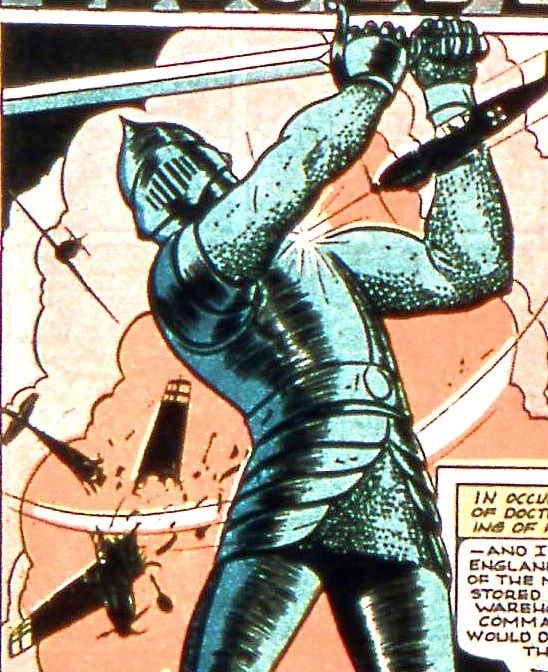
Iron Ace, who debuted in Air Fighters Comics in 1942. He was a British pilot, Captain Robert Britain, who was shot down over France during World War II, and donned the armor of a knight from the Charlemagne era to fight the Nazis. And that’s….it? He wasn’t possessed by the warrior’s ghost or given mystical powers, he just wears centuries-old armor that’s apparently strong enough to withstand machine guns. And seriously, an Englishman with the last name Britain?