All the Tax in China
U.S. critics say that the 15% global minimum tax will be a windfall for China. That may come as a surprise to the Chinese.

Transfer pricing and international tax used to be such a niche topic, an insular little world barely known even to other tax experts. Today, it goes through sporadic headline-grabbing periods before receding back to the academics and accountants.
Judging from a hearing last week at the House Ways and Means Committee, in which Secretary of the Treasury Janet Yellen testified for hours about the administration’s taxing and spending plans, we’re in one of the spotlight moments now. Aside from inflation and alleged over-reach by the Internal Revenue Service, the 15% global minimum tax agreement at the Organization for Economic Cooperation and Development was one of the most prominent topics as Republican lawmakers grilled the secretary.
They’re not happy with the deal, as you might have guessed. The GOP representatives repeated many of their criticisms with how the Biden administration handled negotiations and with the particulars of the agreement, also known as Pillar Two, which was announced in the summer of 2021. The critics especially focused on a complaint that seems to be getting more and more attention–that the deal will disproportionately help China, and that the U.S. got rolled in negotiations as Beijing held out for demands to benefit its state-owned conglomerates.
“President Biden’s global tax surrender to foreign governments will make it better to be a foreign worker or business than an American one. It’s a tax 'deal' only China could love,” said Ways and Means Committee Chairman Jason Smith, R-Mo., in his opening statement.
“There's no reason that we should expect that China is going to play nicely with regard to these rules,” said Rep. Kevin Hern, R-Okla., claiming that there’d be no way to ensure that China is being transparent about its “state-owned, state-regulated enterprises.”
“I mean, they’re kicking out auditors right now,” he added.
These claims repeated points which critics have been making for a while now. In a letter to the OECD last month, Rep. Smith claimed the OECD’s enforcement provisions for the global minimum tax, the Under-taxed Profit Rule, would “never be effective against companies backed by the Chinese Communist Party.” And last week, former Treasury official Aharon Friedman called the deal a “boon for Beijing” in an opinion piece for the Wall Street Journal. Republicans have been raising concerns about China’s treatment in the agreement since before it was even finalized back in 2021.
Of course, right now there’s a clear bipartisan consensus that China represents a threat to American security and prosperity. Between the meandering (alleged) Chinese spy balloon and the widespread influence of China-based social media giant Tik-Tok, fears about the ways that the country can wield its global power are at an all-time high. It recalls some of the periods of the Cold War with Russia–but topped with early ‘90s anxiety about Asian economic might. (Except then it was Japan.)
Just how valid are these concerns about the OECD deal? Well, like everything considering our relationship with China, it’s complicated and nuanced.
Back in 2021, Sen. Mike Crapo, R-Idaho, penned a letter to Treasury demanding answers to several questions, including whether China would receive a special treatment. Crapo noted comments from Pascal Saint-Amans, then one of the OECD’s top tax officials, which suggested that a “carveout” might alleviate China’s concerns that the deal would hit its tax incentives.
Saint-Amans denied that he meant China would get a special exemption, and in retrospect it’s pretty clear that he was referring to the substance-based carveout, which reduces a company’s taxable income under the OECD rule based on its amount of tangible property and payroll. That applies everywhere Pillar Two is implemented, not particular to any jurisdiction.
It may well be that the carveout will benefit China a great deal–but as far as I know, there’s no reason to think it would benefit the U.S. any less. Both countries have a lot of economic substance. U.S. officials are worried that Pillar Two will still apply to U.S. companies because many of our incentives are non-refundable–but the same is true about many Chinese tax incentives, such as its lower tax rate for companies in tech or software.
Friedman’s WSJ op-ed lays out several concerns about Pillar Two and China, in more detail than most of the political rhetoric. He notes that the OECD will grant an exemption for “government entities,” defined as those partially or wholly owned by a government, which fulfill a “government function” (or manage an investment funds), and does not “carry on a trade or business.”
When reading the definition as a whole, including the OECD’s commentary, it seems obvious that it’s meant to exclude the kinds of state-owned businesses that China uses, making them ineligible for the exemption and within the scope of the tax. But given how thoroughly entrenched government is in the Chinese economy, there are bound to be gray areas. Friedman notes that defense contractors, whose only client is the same state they’re controlled by, could fall under the exemption, as they “only provide products or services for use by that government to fulfill a governmental function.” (But in what sense do those companies compete with U.S. firms?)
As for information-sharing, the OECD is still hammering out the details of how that would work, and what the potential consequences of noncompliance (or misreporting) could be. Remember, Chinese companies would need to affirmatively prove that they’re not subject to the UTPR–to the satisfaction of the country applying it, not China. That could make it harder for them, or any bad actor, to flout the rules.
But this project requires governments to view companies more holistically than they have before–which means acting with greater certainty based on information about what happens outside their borders. That will require a new degree of trust that wasn’t necessary before–and will vex these efforts to work multilaterally. But the groundwork–including information-sharing agreements already in place–is there.
Defenders of the project could note that the OECD deal doesn't "let" China do anything it couldn't already done through its own sovereignty. The whole points is to discourage countries from acting more aggressively. What the deal does, arguably, is allow China more ways to potentially tax U.S. companies while still ostensibly complying with global tax norms. But if we don't think they're going to follow the rules anyways, what's the difference?
From where I sit, the China/Pillar Two stuff is about a third legitimate concerns, and a third using the Chinese bogeyman to dress up more general problems with the OECD plan.
The final third relates to the nuances and contradictions with our overall relationship with China. This is hardly my area of expertise. But I’m old enough to remember when Congress voted to give China permanent normal trade relations (a status it still holds today), with the hopes that through business ties with the West, Chinese society would slowly but surely liberalize and democratize, and that a growing middle class would eventually challenge the authoritarian regime.
It doesn’t seem like people think that way anymore–but even the fiercest China hawks aren’t calling for us to throw up economic walls and treat China how we treated the Soviet Union, or how we treat Cuba today. That leaves us as uneasy, reluctant trading partners.
Trade requires some common understanding of rules, which is what all of the OECD’s work is about. And it requires some degree of, yes, trust.
DISCLAIMER: These views are the author's own, and do not reflect those of his current employer or any of its clients. Alex Parker is not an attorney or accountant, and none of this should be construed as tax advice.
LITTLE CAESARS: NEWS BITES FROM THE PAST WEEK
- Not a surprise, but the U.K. is continuing with its implementation of Pillar Two, despite its recent political upheaval. The Spring Budget announcement states that they'll be implementing the global min tax, what they're calling a "multinational top-up tax," in the Spring 2023 Finance Bill, and it will be effective for tax years beginning after December 31, 2023. The announcement includes a policy paper with more information. One interesting note--they estimate that implementing the policy will create £8.2 million annually in new administrative burden, as well as £47 million in both "IT and staff costs." That's a total of $66.5 million in U.S. dollars. We haven't seen similar estimates for U.S. implementation of the still-to-be-enacted legislation. The U.K. announcement also includes changes to its transfer pricing and patent box rules.
- Some more on the wealth tax--just days after President Biden included a version of wealth taxation in his budget request, 130 members of the European Parliament are calling for a "global wealth tax," in a letter published in Le Monde, the French newspaper. (Unfortunately, in French, and I haven't been able to find an English translation.) "What we have achieved for multinationals, we must now do for the wealthy," the letter, co-signed by French-born U.C. Berkeley professor Gabriel Zucman, stated. Proceeds from the tax would fund green programs, under this proposal. This is yet more evidence that the discussion is starting to shift from multinational tax avoidance to wealth taxation.
- The OECD announced Wednesday that Mexico has deposited its "instrument of ratification" for the multilateral treaty arising from the 2015 Base Erosion and Profit Shifting project. This means that it's notifying the organization that the treaty has been ratified by its parliament and will take effect on July 1. The treaty includes stronger language against "treaty-shopping" and to establish a taxable nexus in the jurisdiction from a foreign entity. Almost 10 years ago I heard a Mexican tax official claim that the country was still on the "BEPS for Dummies" stage--it's come a long way.
PUBLIC DOMAIN SUPERHERO OF THE WEEK
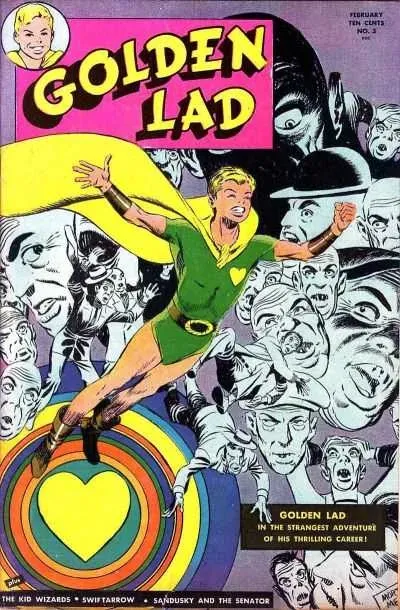
Golden Lad, who premiered in Golden Lad #1 in July 1945. Tommy Preston gained superpowers from the Aztec "Heart of Gold," a magic artifact he found in his grandfather's antique shop.
Contact the author at amparkerdc@gmail.com.