Accounting for Amount B
A promising OECD initiative seeks to simplify routine tax matters to give some relief to beleaguered cash-strapped tax authorities. But just because the issues aren't sexy doesn't mean they won't be complicated.

One of the most important but least-discussed provisions in the Organization for Economic Cooperation and Development’s global tax project is Amount B, which seeks to aide tax administrations–especially the poorer, more resource-constrained ones–by coming up with formulaic determinations for certain functions like marketing and distribution.
A problem with writing about Amount B is the same reason it could actually work as a policy–the underlying activities are just kind of boring.
Don’t get me wrong, this stuff can be important sometimes. But when I’m scanning recent OECD guidance looking for potential newsletter topics, “baseline distribution functions” doesn’t exactly jump out at me. Not nearly as much as the sexy tax topics like valuable intangible assets, taxing transactions in the digital sphere, or even commodities.
The idea behind Amount B is that some marketing and distribution activities in the jurisdictions with consumers create significant tax disputes–but they really shouldn’t. The underlying activities are normally routine and not a significant risk for base erosion or tax avoidance. Simplifying tax administration here would be a rare win-win in tax policy–corporations would get more certainty and protection from audits, while it would free up resources for tax authorities to investigate more problematic areas. This was seen as crucial to getting buy-in from developing nations, who continue to see little benefit from the overall tax project.
It’s not necessarily true, though, that things like distribution are always non-controversial. One of the things they’re looking at is commissionaire arrangements, which international tax old-timers will remember was once a hot topic when the OECD tweaked the rules on permanent establishments during their previous comprehensive global tax project in 2015. Commissionaires sell products or services on behalf of a multinational corporation (sometimes even as a subsidiary), but they ostensibly have discretion about the exact terms of the deals. Critics claimed this allowed companies to sell into jurisdictions while technically avoiding the PE rules for a taxable nexus.
And Amazon.com came under fire a decade ago for allegedly circumventing the PE rules for similar issues. Warehousing and distribution were classified as auxiliary under the prior rules, not enough on their own to create a taxable presence in a jurisdiction. But distribution is hardly auxiliary to Amazon’s business model, and this arrangement struck many European lawmakers as unfair. The OECD tweaked the suggested wording for treaties and Amazon restructured its subsidiary structure.
And as for marketing, anyone familiar with “Mad Men” will know that it can sometimes be anything but routine. This was actually one of the central conflicts of the show, which chronicled 1960s America through the eyes of Don Draper, a fictitious star ad-writer at a top New York ad agency. Some characters claimed the “creatives” like Draper were mere window dressing for the underlying business, selling TV and newsprint ad space. The copywriters see themselves as central–changing consumer perceptions and creating market demand in the first place. “I sell products, not advertising,” Draper once declared at a meeting.
In the series finale, Don Draper achieves immortal status in the advertising world by concocting the iconic Coca-Cola “I'd Like to Buy the World a Coke” TV commercial. I only bring this up because Coke recently lost a high-profile tax case that was also all about marketing, with the company claiming that its foreign subsidiaries were owed a substantial cut of its returns due to the consumer demand they generate. This seemed a bit suspect to the government, as it argued the company was undervaluing one of the most recognizable brands in the history of marketing. The Tax Court ultimately decided that the subsidiaries needed to pay more to use Coke's intellectual property—maintained by the Don Drapers back in the home office. But it was a contentious enough issue to merit a years-long legal battle.
Remember, the original idea with Amount A of Pillar One–another part of this tax project, which allocates part of extra-normal profits to market countries–was to recognize the existence of valuable marketing intangibles in those jurisdictions. When marketing can either produce routine returns or extraordinary returns, you can see why it’s a bit complicated.
The point is, while marketing and distribution can sometimes be routine, they certainly aren’t always routine. And this is emerging as one of the central challenges for Amount B, coming up with a way to distinguish between those two. There’s a fear that rather than preventing disputes, Amount B will merely move them from pricing to scoping. Instead of arguing about the correct return for a routine distribution function, tax authorities and taxpayers will argue about whether something really is a routine distribution function—not actually fixing anything and potentially creating even more complexity and confusion.
Nearly half of the Amount B consultation document, which the OECD released in July, concerns the scoping issue. The document lays out two potential plans for determining scope, one through a single formulaic determination of routine functions, and the other with formulas for both routine and non-routine functions, so the latter can be eliminated. It’s a question that often arises in tax policy—is the easiest way to identify something to define what it is, or what it is not?
Aside from this, the OECD still hasn’t really answered the central question for Amount B. Will it be a safe harbor, something that companies can use when it’s convenient and challenge when it isn’t? Or will it be a new allocation that jurisdictions can assert, just like Amount A and much of the global tax project generally? (The section that would lay this out is now marked "[PLACEHOLDER]," with a footnote explaining that further work will be done.)
It’s a little odd to be preoccupied with fine-tuning the exact measurements of Amount B while still not explaining what it’s for. But that will likely be the hardest question from a policy and political standpoint, one which the interested parties may wait to compromise on until it’s absolutely necessary. A safe harbor could be the more comfortable solution, in keeping with the overall tax system’s increasing reliance on soft enforcement nudges. But will developing countries, incensed (whether justified or not) that the overall project is neglecting their needs, accept this? If the richer nations are getting more taxing rights through the global minimum tax, why should they accept something optional?
On the other hand, would an Amount B taxing right be yet another Pandora’s box, a Trojan horse for growing formulary apportionment in the global tax system? (To mix up some Greek mythology.)
By Jove, time will tell.
DISCLAIMER: These views are the author's own, and do not reflect those of his current employer or any of its clients. Alex Parker is not an attorney or accountant, and none of this should be construed as tax advice.
LITTLE CAESARS: NEWS BITES FROM THE PAST WEEK
- The stereotype of Canadians is that they’re always polite and unassuming—whether or not that’s true, it’s not stopping their government from aggressively moving ahead on their digital services tax plans, in defiance of the OECD, U.S. government officials, as well as businesses in Canada and throughout the world. The country’s Department of Finance released Friday an updated proposal for a DST targeting the revenue from select online activities, as well as implementation legislation for the OECD’s global minimum tax plan and other anti-avoidance and anti-abuse measures. You can check the legislative language and explanatory notes yourself, but I didn’t notice a ton of differences from their release back in 2021. Nevertheless, business groups like the National Foreign Trade Council immediately criticized the government’s actions. This comes shortly after the OECD announced a 138-country agreement—not signed onto by Canada—to delay DSTs for another year. Canada says they’re through with waiting, and are just sticking to an agreement they made back in 2021. But some observers are predicting that such a high-profile departure from the OECD consensus could lead to a larger breakup.
- The United Nations released an “advanced unedited version” of a report on the “promotion of inclusive and effective international tax cooperation at the United Nations,” which follows a resolution passed last year to investigate creating a new tax forum. The report is critical of the OECD’s current role, claiming they don’t allow developing countries to cooperate on equal footing with the organization’s members, who are generally Western and richer. It lays out three options—a vagueish “non-binding multilateral agenda for coordinated actions,” a new multilateral convention (like today’s tax treaties but no longer bilateral), and a binding “framework convention” that sounds to me something like a World Trade Organization for taxes. The case that developing countries are at a disadvantage at the OECD, as laid out in the report, seems convincing. But we’ll see what happens when this momentum hits opposition from the United States and others who are very invested in the OECD process.
- This is a pretty minor issue, but it’s the kind of thing that catches my eye—the U.S. Treasury Department released proposed regulations Monday to update the regulations on filing consolidated returns to “reflect statutory changes, modernize language and enhance clarity.” Among the changes are to replace the word “possession” with “territory” in reference to U.S. territories like Puerto Rico or Guam. (“U.S. possessions” isn’t a term you often hear today, but it shows up both in regulations and the tax code.) This is part of the regulations’ elimination of “antiquated or regressive” terminology, as part of Treasury’s Equity Action Plan and the Biden Administration’s executive order for “Advancing Racial Equity and Support for Underserved Communities Through the Federal Government.” It’s yet another reminder of how intertwined the territories are with U.S. law—I find many mainland Americans do not know that Puerto Rico has its own tax system, authorized through Congress.
PUBLIC DOMAIN SUPERHERO OF THE WEEK
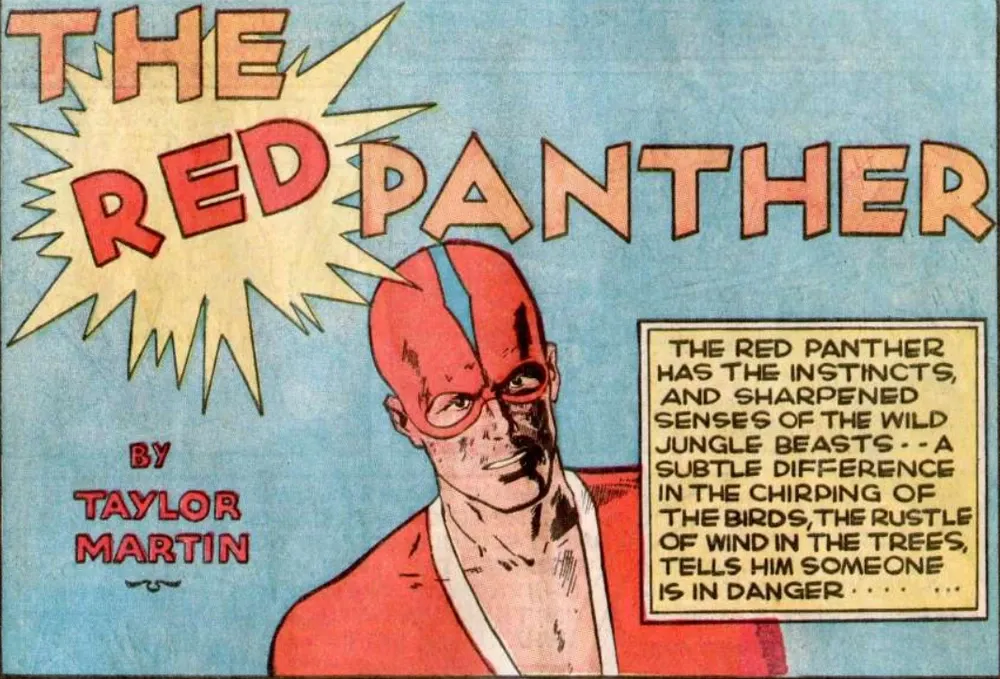
Every week, a new character from the Golden Age of Superheroes who's fallen out of use.
Red Panther, premiering in Jungle Comics #2 in 1940. Supposedly wearing the skin of a mythical panther, this hero uses a bow and arrow, super-strength, as well as mysterious teleportation powers to act as "protector of people who cannot defend themselves" and to fight "against those who would prey upon the innocents of Africa." (Not even going to get into the weird white savior tropes on display here.)
Contact the author at amparkerdc@gmail.com.