The AMT and the OECD: Closing the Other Tax Gap
Why the OECD's global project isn't hopeless-even for the U.S.--after Congress nixed changes to its international code.

Congress is on the cusp of passing the biggest piece of tax legislation since the Tax Cuts and Jobs Act–but international taxes got left on the cutting room floor.
Spooked by the European Union’s slow-walking and potential threats to U.S. competitiveness, crucial Democratic Sen. Joe Manchin nixed the provisions which would have brought our system closer to the standards set by the Organization for Economic Cooperation and Development’s global minimum tax agreement, touted by the Biden administration and the G-20 as a historic achievement.
True, the bill will include a 15% corporate book minimum tax, which targets the worldwide income of the biggest U.S. multinational corporations. But despite some conceptual similarities, the tax is fundamentally different from the 15% global minimum tax which is the centerpiece for the OECD’s sweeping international tax overhaul.
So with little chance for the Biden administration to enact more changes to the international tax code for the foreseeable future, is the U.S. out? Will the OECD have to go ahead without the world’s biggest economy as it tries to forge ahead on its troubled project?
Not quite.
There has been a frustrating tendency to talk about this project in binary terms–is the U.S. in or out, will the EU stop or go? That’s probably a logical way to look at most international accords. But the OECD works with the soft power of norms and recommendations–its officials sometimes joke that the O in OECD stands for “optional.” And in this case, with a framework that was largely inspired by U.S. tax laws, it’s hard to imagine the U.S. ever being totally “out.” Likewise, it will also likely never be in full compliance–it’s just not our way to fully accommodate our laws to international standards.
But when the wreckage of this tumultuous Congress is gathered and tax policymakers look ahead, they may find that the U.S. and OECD aren’t as far apart as they look, especially if the 15% book minimum tax is enacted. But what that means, and where they can go from here, isn’t so much a policy question as a matter of the tricky global politics of taxes.
Earlier this week I laid out the major conceptual differences between the OECD global minimum tax and the book minimum tax. They’re fundamentally different policies–not so much in coordination or opposition as on separate, parallel paths. It’s a little baffling to foreign observers that Congress would enact a policy so close to the global min tax, without making it compatible. For those close to the congressional process and tuned into U.S. politics, bridging that gap seems all but impossible.
But the book min tax is still a tax on worldwide income–it does raise taxes on foreign profits of U.S. companies. It’s something the OECD could take into account.
The OECD’s global minimum tax (Pillar 2 of the "Two-Pillar Solution") was largely based on the U.S. 10.5% tax on global intangible low-taxed income, enacted by the TCJA in 2017. Because of how foreign tax credits work, the GILTI tax targets the foreign income of U.S. companies, should it be taxed below 13.125%. In that sense, it’s similar to the book min tax. But otherwise it’s very different—it aggregates foreign income, but doesn’t include domestic income. GILTI also gives an exemption for depreciable tangible property, meant to ensure it targets intangible income, like profit from valuable IP. That’s the kind of income that’s often involved in complex tax structures.
The OECD’s tax--recommended legislation for participants to enact--is also different from GILTI. Of course, it has a higher rate. It also calculates on a jurisdiction-by-jurisdiction basis, applying any time a taxpayer’s income in a jurisdiction is taxed below 15%. That’s seen as tighter and more difficult for taxpayers. But it’s also more flexible in some ways. It allows for net operating losses and to carry foreign tax credits forward, which GILTI doesn’t, mostly due to the peculiarities of Congressional budget-scoring.
What does it mean for the U.S. to be “in” the global min tax? They could fully follow the OECD recommendations, but that was likely never in the cards. The OECD’s 2021 summer announcement of a deal noted the possibility of giving GILTI special treatment to ensure it fits in with the new system.
Being “in” could mean that GILTI is deemed to be a fully compliant income inclusion rule, which is the meat of the Pillar 2 tax. That designation is important because Pillar 2 also has an enforcement mechanism, the UTPR, which allows other countries to target the subsidiaries of companies in jurisdictions that don’t participate or keep their taxes low. Having a compliant IIR, in essence, turns off the UTPR in most (but not all) situations. Ideally, if everyone participated, the UTPRs would be present but never used, like nuclear weapons.
If GILTI is deemed a compliant IIR, then for most purposes the U.S. is participating in the regime.
This is why those Pillar 2/GILTI differences are important. How close does GILTI need to be, to be let into the OECD clubhouse? With the GILTI rate at 10.5%, it would be tough for the Biden administration to ask for an exemption, after it pushed for the higher 15% rate. But with this new min tax, idiosyncratic as it is, there’s a case to be made that the U.S. is still getting the job done in its own peculiar way. As Americans do.
In the past, the OECD has been smart enough not to bet on anything from Congress. The 2015 Base Erosion and Profit Shifting project, which dealt with similar issues in taxation, was carefully designed to move ahead with or without new U.S. legislation. (Though Congress ended up enacting most of those recommendations in the TCJA, anyways.) And the Trump administration argued that GILTI, as it is, is likely harsher to taxpayers than Pillar 2, due to the lack of NOLs and carryforwards. They likely never planned to push Congress for changes in GILTI.
However the numbers add up, this is ultimately going to be much more about politics than policy. With the perception that Pillar 2 is stuck, (although picking up momentum outside of Europe), apparent U.S. participation could be invaluable towards further implementation. On the other hand, the perception that the U.S. is getting a free pass could be fatal.
Predicting the outcomes of tax policies is hard enough. But anyone who claims to be able to predict global tax policies is clearly selling flimflam. Wherever this tax project ends up, it still has a long ways to go.
DISCLAIMER: These views are the author's own, and do not reflect those of his current employer or any of its clients. Alex Parker is not an attorney or accountant, and none of this should be construed as tax advice.
OTHER NEWS OF THE WEEK
You’d think it’d be a quiet week in the tax world outside of reconciliation, but no such luck. Some of the int’l tax items that caught my attention….
Ron Wyden continued his crusade against the tax practices of Big Pharma, now accusing Abbott Laboratories and Merck & Co. Inc. of stonewalling the Senate Finance Committee’s investigation into how the TCJA allegedly allows them to shift income offshore and obtain a low effective tax rate. This follows a report from early July highlighting alleged tax avoidance from AbbVie. This coincides with a JCT analysis, touted by Wyden, showing that pharma is a big payer under the Inflation Reduction Act’s 15% AMT. Starting to notice a theme here....
Sen. Chris Van Hollen (formerly my representative) is continuing his push for more tax transparency, appearing with the FACT Coalition to present a report claiming that investors are harmed by the lack of disclosure of tax structures. Van Hollen wants country-by-country tax reports, which multinationals already submit to the IRS and other tax authorities, to be made public. The campaign for public tax disclosure has always interested me, because it originated in several different spheres—not only tax justice advocates but also anti-corruption movements. While Van Hollen’s law seems far from enactment, something to keep an eye on.
House Ways & Means Chairman Kevin Brady (R-TX) and Rep. Kevin Hern (R-OK) are pushing Treasury for more info on Pillar 1’s economic and revenue impacts. What are they expecting to find?
PUBLIC DOMAIN SUPERHERO OF THE WEEK
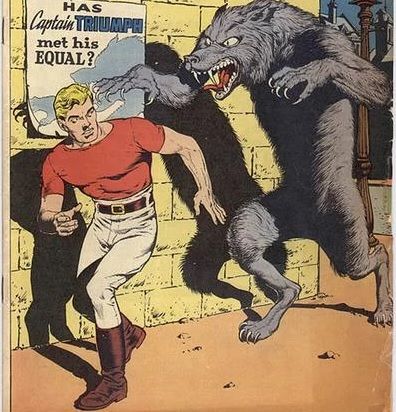
Captain Triumph, created by Alfred Andriola in 1943 for Crack Comics. Endowed by the Fates of Greek mythology with special powers, Lance Gallant seeks revenge for the death of his twin brother, Michael, in World War II. He can also combine with his brother's ghost, by touch a T-shaped birthmark both brothers have, to gain further powers such as invisibility and flight. (This is unusually complicated for an origin story.) The two brothers fight for justice.