The Age of Digital Services Taxes?
The OECD's plan to address taxing the digital economy faces almost impossible odds. Does that mean that unilateral, gross-based digital services taxes are here to stay? What does that mean for the global tax system?

If there’s one thing (almost) everyone agrees on, it’s that Pillar One is dead. The Organization for Economic Cooperation and Development’s plan to reallocate income from digital (and other) transactions faces long odds for enactment, despite the 140-country agreement announced back in the summer of 2021. With a multilateral treaty necessary for passage–and with Republicans solidly opposed to the proposal, controlling well over the one-third of the Senate necessary to block treaty ratification–the U.S. is almost certainly out. And as goes the U.S., so goes the world, it would seem.
But there’s no real agreement on what will happen. Will the OECD go back to the drawing board and come up with a simpler plan? Or will digital services taxes, the unilateral levies which Pillar One was supposed to replace, become a permanent part of the global tax landscape–possibly expanding to cover more transactions? And, potentially, provoking trade wars with the U.S., which has previously threatened retaliatory tariffs over DSTs, claiming they target American tech firms?
The latter may be the likeliest possibility–but it’s still an uncertain future that’s hard to imagine indefinitely. DSTs were originally supposed to be temporary measures, and they tax revenue, not profit, crudely targeting only a few specific digital activities without careful consideration of how to weave into the larger international tax framework.
If they become permanent, they could become more than a headache for the Facebooks and Googles for the world. DSTs could signal a major shift away from the income concept that has governed corporate taxation for well over a century–a major upheaval of the global tax system.
“Are we in a world in which it’s Pillar One and net basis taxation?” asked former Treasury official Robert Stack during a tax conference in Washington, D.C. last month. “Or, if that fails, a world of gross-based taxation? Not just DSTs, but all sorts of things.”
Digital services taxes apply to gross revenue because, supposedly, they were a quick temporary patch to the international tax system, to capture income that was slipping through the cracks. Most tax treaties still define a permanent establishment, or a taxable presence, as based on physical facilities or employees. (Not just any facilities or employees, but those involved in the central operation.) These rules made it easier for companies in the digital sphere to operate in jurisdictions without ever really existing there, as far as the tax system was concerned.
Furthermore, the value drivers of these businesses are often intangible assets, like intellectual property, that are difficult to value. Think of Amazon.com’s algorithms or Facebook’s branding. These are often so unique that it’s hard to use the arm’s-length standard–the universal benchmark for valuing assets, based on what independent parties would have paid–to come up with an estimate of their value. And without valuing the assets, there’s no way to value the costs–which is an essential input for any calculation of profit.
“A new tax on profits within the existing international corporate tax framework would face exactly the same limitations that are at the root of the problem,” according to a 2018 “Impact Assessment” report from the European Commission, which paved the way for its DST proposal. “Levying a specific tax on profits derived from digital services is complex. It requires determining the corresponding costs incurred in relation to the digital service as companies in most cases earn also other revenues (not falling under the scope of the new tax).”
Also, perhaps a more direct consideration, a new income tax would violate existing tax treaties–the whole reason that international negotiations are needed.
The EU’s DST wasn’t enacted, but it became the model for national taxes passed by individual European states.
Of course, the OECD’s 15% global minimum tax, Pillar Two of the project–which faces much better odds–is supposed to deal with some of these issues regarding intangibles. But if that’s leading countries to reconsider the gross basis of their DSTs, I’ve missed it.
If DSTs work, the next temptation for jurisdictions could be to expand them to other areas. After all, as the OECD has said repeatedly, there really is no “digital economy” distinct to the global economy. All businesses are digital.
And those who haven’t yet enacted DSTs could achieve similar results through aggressive audits. (Some poorer developing countries have long used revenue or “turnover” as a basis for income taxation–without the resources for a more extensive analysis, simply “deeming” a certain percentage to be the arm’s-length return.)
“If we cannot prove to the world that net [taxation] is possible–the world needs money. They’ll think, ‘we can do gross because that’s a lot easier,” said Achim Pross, the acting deputy director of tax and administration at the OECD, also speaking at the December tax conference. “I think that’s the essential question, more conceptually and long-term.”
There are a lot of reasons why there’s such a push towards destination-based gross taxation in the world. In a complicated economy, it’s a lot simpler than trying to work out issues of business models and value drivers. A person sitting at a computer isn’t always easy to pin down to a particular jurisdiction, but it’s possible. And market countries with consumers feel they’ve been missing out on their fair share anyways. The U.S. even briefly flirted with a cash-flow tax in 2017.
Perhaps the endgame is universal acceptance of digital value-added tax. Except what’s happening now is gross taxation outside of the VAT frame–without its methods of passing the tax along the value chain, and time-tested systems for self-enforcement and locating the destination of a transaction. That can lead to significant economic distortions, especially for companies which aren’t earning money hand-over-fist like Facebook or Google.
It may well deal with the complexity. But a blunt instrument isn’t always the right answer.
DISCLAIMER: These views are the author's own, and do not reflect those of his current employer or any of its clients. Alex Parker is not an attorney or accountant, and none of this should be construed as tax advice.
2022 Tax Reads
Every year I try and read a few books on tax, mixed into my regular diet of crime novels, histories, sci-fi and comics. Here are a few that stood out to me--
Learning to Love Form 1040: Two Cheers for the Return-Based Mass Income Tax, by Lawrence Zelenak. A brief case for why tax returns are a good thing, even if they're a bit inconvenient and inefficient, and could use improvement in the U.S. I was less interested in the argument, which seemed a bit abstract, as I was in the fascinating history of how the U.S. adopted broad-based income taxation during World War II, when everyone was urged to do their part for their country. (See this famous Donald Duck cartoon acquainting Americans with this new-fangled concept of filing yearly taxes.)
Pledging Allegiance: American Identity and the Bond Drive of World War II, by Lawrence Samuel. Kind of a continuation from the above themes, and not strictly tax-related--war bonds have long been one of my weird obsessions. Not because I'm a World War II enthusiast, but just because I think it's a fascinating (and forgotten) story from that time. How did the U.S. convince millions of Americans to voluntarily give the government millions of dollars for a common cause? True, they'd get it back, with interest--but they bought them out of patriotism as well as economic self-interest. It was, as the campaigns put it, a chance to purchase a "share in America." Having written about tax morale, the willingness to pay taxes beyond enforcement, war bonds are an interesting real-life case. I first got to know this history writing about how comics and superheroes played a role in pitching this to the public, and Samuel's book is perhaps the most comprehensive look at how it all happened. Including another fascinating story-within-the-story here, how Treasury made outreach to African-Americans a specific priority, for nuanced socio-political reasons.
Rebellion, Rascals, and Revenue: Tax Follies and Wisdom through the Ages, by Michael Keen and Joel Slemrod. A lively and interesting history of taxation worth reading for wide selection of stories and anecdotes, even if they're only tied loosely tied together by a central narrative. Did you know that England's window tax, meant to be a proxy for house size and wealth, changed building design and lead to disease outbreaks from windowless and poorly ventilated buildings? That for most of history, tax enforcement was essentially on commission, with collectors entitled to keep most of what they collected in exchange for a flat fee from the government? That some kingdoms in India taxed lower-class men for growing mustaches, and lower-class women for covering their breasts? The 500+ page book is filled with items like this, as well as interesting thoughts about the nature of taxation.
Retail Gangster: The Insane, Real-Life Story of Crazy Eddie, by Gary Weiss. OK, this one's a stretch, but bear with me. This is the story of the Antar family, who controlled one of the most famous retail electronics chains on the East Coast in the 1980s and 90s--boosted by flamboyant TV spots and even more flamboyantly outrageous fraud. It was a bit before my time, and if not for books like this I'd never believe it could have happened. Tax evasion was among the many crimes in their web of lies--especially from sales tax. As Crazy Eddie began as one store in Brooklyn, it pocketed sales tax by under-reporting sales, apparently a long practice in the Antar's Syrian-Jewish communities. (And, as their chain grew and went public, they slowly drew back on the practice to give the illusion of skyrocketing growth--brilliant!) Told from interviews and the voluminous court filings that resulted from the endless litigation and criminal prosecutions following Crazy Eddie's brief flight to the sun, this is an interesting portrait of white-collar crime from some very blue-collar crooks. The structure of their con is fascinating, but the personalities that would engage in such a sure-to-fail venture are even more so.
Did you read any good tax books last year? Let me know and I may do a follow-up post.
LITTLE CAESARS: NEWS BITES FROM THE PAST WEEK
- The U.S. Department of Treasury issued its first guidance on the 15% corporate alternative minimum tax last week, addressing what it said were "time-sensitive" issues. These include a potential safe harbor for identifying applicable corporations under the tax. This is just the first of what's sure to be a long process of implementation. (Insider note: Ashley Schapitl, spokesperson for the Senate Finance Committee during the bill's passage, has taken a job at Treasury to lead "communications on Inflation Reduction Act implementation.")
- The OECD released 13 new rulings on tax regimes and whether they violate their rules on harmful tax practices, set out in the 2015 Base Erosion and Profit Shifting project. What caught my eye first: Hong Kong's special tax regime for shipping, its biggest industry, was deemed to be in compliance.
- The White House issued a "white paper" outlining how it plans to implement some of the electronic vehicle credits in the Inflation Reduction Act. It's non-binding, and its audience may not only be taxpayers but the European Union, which has been gearing up for a potential trade war over how the E.V. credits are structured. The white paper stated that Treasury will take a broad view of what constitute "free trade agreements" for the purposes of the statute's exemptions, potentially easing them vis a vis the EU.
PUBLIC DOMAIN SUPERHERO OF THE WEEK
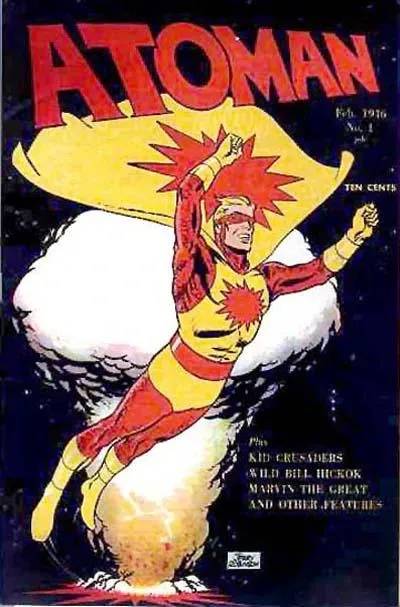
Atoman, (like Atom Man but missing an "M"), whose first appearance was in 1946 in Atoman #1. A scientist who absorbed nuclear energy from his lab giving him superpowers. As he put it, "Evidently my body is so geared as a result of working on radium and uranium that it can explode atoms and give me atomic strength." Unlike the similar DC Comics character "The Atom," he cannot shrink himself down to the size of an atom, however.
Contact the author at amparkerdc@gmail.com.