QDMTTs, CFCs, and Potential Complications
Practitioners and taxpayers have flagged yet another potential glitch in how the OECD's new global minimum tax could interact with the U.S. system.

As I wrote back in March, the qualified domestic minimum top-up tax is looking to be the most crucial part of the Organization for Economic Cooperation and Development’s new 15% global minimum tax. It’s the teeth of the new system, the one that companies will most often come into contact with. (Leaving the income inclusion rule and the under-taxed profits rule as the jaw muscles, to stretch this metaphor as far as it will go.)
Unfortunately, it’s a bit of a mouthful, and there’s no catchy acronym yet like GILTI (“guilty”) or CAMT (“camtee”). Apparently one joke that’s beginning to catch on with practitioners is that QDMTT should be pronounced “Q-Dammit!”
The IIR and UTPR are the global minimum tax’s primary rules to enforce the 15% rate. Countries impose IIR on the foreign subsidiaries of their own companies if that income is taxed at less than 15% in whatever jurisdiction they’re operating in. And they apply the UTPR to subsidiaries if the parent company is in a jurisdiction that doesn’t have an IIR, or allows taxes to fall under the limit. One way or another, if income is held in a low-tax jurisdiction--as profits related to intellectual property or intangibles often were--it will be taxed at a rate that should discourage companies from using tax havens altogether.
But ultimately, if the system works as intended, the IIR and UTPR will mainly serve to incentivize countries to tax their own domestic income at the right rate. They can do this by raising their overall tax rates or repealing domestic tax benefits, But the IIR and UTPR operate with unique income tax measurements, excluding substance-based factors like payroll or tangible assets and using its own system for timing differences. So raising rates, alone, won't necessarily capture all of the income that would get swept up by the IIR and UTPR.
Thus enters the QDMTT. It’s a new tax the OECD recommends, though does not require, for countries hoping to capture all of the global minimum tax base. It gets priority over everything else. It also allows for the most flexibility among the new OECD tools–as a domestic tax, countries have the most leeway to incorporate their own measurements and practices into its enforcement.
Which means it’s also where the most disputes and complications are likely to arise, when the rubber hits the road.
One potential glitch, flagged by the National Foreign Trade Council in its letter to the OECD earlier this month, may be how the tax interacts with the U.S. tax on global intangible low-taxed income, as well as other national controlled foreign corporation rules. An apparent U-turn in how these taxes are to be prioritized could raise the possibility of double taxation and general confusion.
Because this new global minimum tax–also known as Pillar Two–will be overlaid on top of the existing rules, it generally takes into account all existing taxes and only applies if they don’t adequately cover the base. CFC taxes–those that countries apply on the foreign subsidiaries of parent organizations based in their jurisdictions, usually on passive income such as interest or royalties–are included in the calculation to see if an entity’s tax rate is above 15%. (For the most part--there is a limitation.) And the OECD recently confirmed that GILTI is a CFC rule, albeit a “blended” one that aggregates across jurisdictions.
Practitioners initially thought that this would be true for the QDMTT as well, and the rules released by the OECD back in 2021 seemed to confirm this. But new administrative guidance from the organization in February stated that the QDMTT is applied before CFCs are factored in. Subsidiaries don’t get credit for those taxes against the domestic minimum tax.
The OECD said this was to avoid “problematic” complexities with trying to reconcile the QDMTT adjustment and credits that the multinational company would receive back home. Furthermore, it’s “aimed at attributing primary taxing rights to the jurisdiction applying the QDMTT,” which makes the most sense to me. Countries almost always get first dibs on income from their jurisdiction, and the OECD risks getting ignored if they try to impose otherwise.
I tried to explain the basic concept with CFC rules a few months ago, and one thing I noted is that they create double taxation, by definition. It’s a tax that one country applies on top of another country’s taxes. Only through foreign tax credits is that double taxation resolved.
But, as the NFTC notes, that’s not true in every case. The applicability of foreign tax credits has been a hot, controversial topic in the U.S. for the past several years. In the case of GILTI, its design ran into foreign tax credit limitations which ultimately caused it to apply in cases where the foreign jurisdiction already applied high taxes. (Despite “low-taxed” being in the provision’s name.) This is due in part to how interest, research & development and other expenses are allocated between jurisdictions under the U.S. system.
Furthermore, the U.S. Treasury Department’s recent foreign tax credit regulations have caused huge amounts of agita among corporate taxpayers, as taxes which have long been creditable now must be reconsidered. Ostensibly, the FTC regulations were mainly to ensure that novel digital services taxes would not receive credits. But the rules create an entire new framework for evaluating whether a foreign tax is really an income tax or not. How that framework would apply to a complex new tax like the QDMTT will be interesting.
Of course, it’s very unlikely that Treasury would want to deny credits for a new OECD system that Treasury itself helped negotiate. And they probably wouldn’t for a QDMTT that closely follows the OECD outline. But, as I noted before, the OECD allows for a lot of leeway in how the domestic minimum taxes can be designed and implemented. Countries will surely want to look for new ways to grab foreign income, especially if it’s coming from U.S. companies. There is a peer review process to see if a QDMTT remains qualified, but it will face a time lag and who knows what kind of disagreements will arise.
This is exactly the kind of thing that the new FTC rules are meant to block. Both Treasury and Congress are very sensitive to the notion that, through broad credits, the U.S. may inadvertently fund unprincipled levies designed to target U.S. companies. Treasury may have to thread a tricky needle here.
So, foreign tax credits against QDMTTs are hardly a sure thing.
This is yet another consequence of the Biden administration’s failure to pass implementing legislation for Pillar Two. If Congress changed GILTI into an OECD-compliant IIR, it would automatically turn off when a QDMTT is present. But, as it stands, GILTI remains outside the OECD system and the potential for double taxation remains.
The NFTC asked the OECD to reconsider the ordering rule. Absent that, it urges countries to commit to providing credit to QDMTTs. We'll see how they respond. In the meantime, the OECD is currently working on a potential safe harbor for QDMTTs, that would make compliance easier and presumably smooth over these potential incongruities. So far, little is known about how it would work–and it’s likely to be another optional recommendation, not a requirement.
These implementation steps could prove to be the crucial juncture for the entire project, determining whether it can work or if the parties will all be back at the drawing table in another decade or so.
DISCLAIMER: These views are the author's own, and do not reflect those of his current employer or any of its clients. Alex Parker is not an attorney or accountant, and none of this should be construed as tax advice.
LITTLE CAESARS: NEWS BITES FROM THE PAST WEEK
- As I noted last week, the Senate Finance Committee held a hearing May 11 to highlight what Chairman Ron Wyden, D-Ore., claims are unacceptably low effective tax rates among pharmaceutical companies, which he says are enabled by the 2017 Tax Cuts and Jobs Act. It ended up being a pretty one-sided affair, as the committee's Republican members and witnesses used their time to blast the OECD minimum tax agreement and the Biden administration's role in negotiating it. It's too bad, because I think the discussion could have benefited from a more well-rounded debate about Wyden's findings, including the role that R&D credits play and how much the Democrats' proposed fixes would really change things. Nevertheless, there's plenty of material to pour over, including a memo from the committee staff, Council on Foreign Relations Senior Fellow Brad Setser's testimony further laying out the case, and an analysis from the Joint Committee on Taxation.
- The Group of 7 nations summit in Japan is this week, and the organization release a communique on May 12 outlining many of its positions--including its commitment to the OECD tax project. Nothing terribly new here, but the affirmation of the stalled Pillar One project is interesting, and seems to set further expectations that the organization will produce some kind of agreement by July, or potentially lose its support. Also note its promise to assist developing nations in implementing the agreement.
- The Brazil Senate passed international tax legislation last week, taking another step to bring the country's international tax system in line with the rest of the world. Brazil has long been an outlier, using its own margin-based tax system rather than traditional transfer pricing. But as South America's largest economy aims to join the OECD, it has been forced to mesh its system with the OECD model. This has huge implications for U.S. companies doing business in Brazil, especially in regards to foreign tax credits. It also is yet another reminder that, despite its many flaws, the arm's-length principle still rules supreme.
PUBLIC DOMAIN SUPERHERO OF THE WEEK
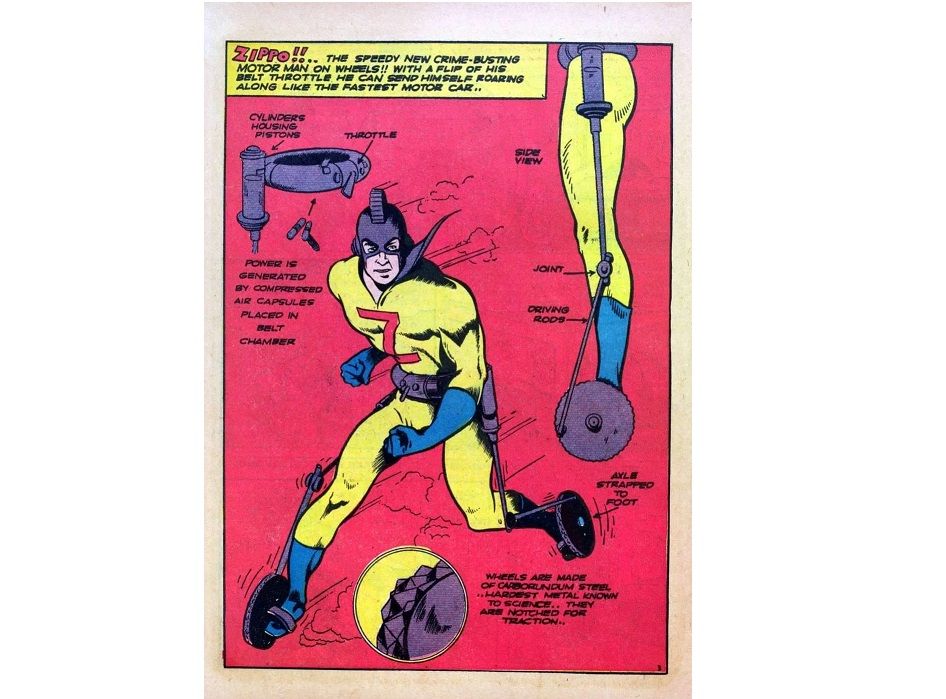
Zippo, appearing in Clue Comics #1 in 1943. Zippo, a.k.a. Joe Blair, is a crime-fighting private detective who built himself a contraption with wheels on his shoes, which can propel him to speeds of 65 miles per hour or more.
Contact the author at amparkerdc@gmail.com.