Tax and Trade
If Pillar One fails, the U.S. could look at tariffs as the latest tool to defuse digital services taxes. It would be the latest example of the tax and trade spheres merging.


The Organization for Economic Cooperation and Development’s self-imposed deadline to produce final text for a multilateral convention to implement “Pillar One” is a little over two weeks away. This is the agreement that would give market jurisdictions a slice of additional income from sales into their jurisdiction, including online-only sales, under an entirely new framework that would accompany the century-old transfer pricing and treaty-based system.
My periodic updates on this probably seem full of doom and gloom, as the OECD has blown by several deadlines, and may finally be out of justifications for further delays. But I at least try to give them the benefit of the doubt, and keep an open mind to the possibility that this will all somehow work out. Who knows what the future will bring, perhaps there could be some unforeseen event which scrambles the dynamics. Stranger things have happened.
But already, the sides seem to be preparing themselves for failure–and if the agreement succeeds, there’s still the question of whether it will ever become operational if the Senate blocks ratification of the multilateral treaty, which seems inevitable at this point.
While the dealmakers and power brokers all publicly commit to this process, everyone’s thinking about what happens after its all-but-certain failure. But few are talking openly about what this will mean. And if there’s a game plan for how to proceed after that, I sure haven’t seen it.
The only thing I can say for sure about the post-Pillar One climate is that all eyes will return to the U.S. and its tariff process. The whole point of Pillar One was to get countries to repeal the digital services taxes they had passed but suspended in recent years, which would tax the revenue from online activities such as advertising or data collection. The U.S. has viewed these as an attack on its tech industry, which still dominates the world. (Despite Chinese success stories like Alibaba and Tik-Tok.) The Trump administration began the process for imposing tariffs on countries using DSTs, but suspended them during OECD negotiations and left the issue for the Biden Administration to figure out.
Biden continued the suspension but, crucially, hasn’t altogether dropped the process. And in other areas, the White House has shown itself willing to use tariffs, which the executive branch has near unilateral authority to impose under Section 301 of the Trade Act of 1974.
If Pillar One is officially dead, then U.S. tech companies will face a cascade of new DSTs, all taking effect at once. The Biden Administration may feel it has no choice but to respond. As then-OECD tax director Pascal Saint-Amans put it, this tax war could turn into a trade war.
That development would continue the gradual merging of two spheres, which have traditionally been separate, with experts and authorities that rarely interact. But in terms of policy, the differences between tax and trade are becoming harder to enunciate.
I wrote about this more than 10 years ago, when Panama challenged its designation as a tax haven by Argentina, which meant that transactions from Panama faced harsher treatment from the Argentine tax authority. (Unfortunately my piece is no longer online.) Panama issued a protest at the World Trade Organization, claiming this was a discriminatory trade practice, as the practical effect of the designation would raise the tax costs of trade between the two nations. The WTO ultimately ruled that tax haven lists must be justified by objective criteria to not be considered discriminatory.
Since then we’ve had the European state aid investigations into the tax practices of multinational enterprises and jurisdictions like Ireland and Luxembourg, which are justified not under tax law but under the rules on competition in the common market. (More or less a trade issue.) And we’ve also had additional WTO complaints on tax matters, including the challenge of the U.S. deduction on foreign-derived intangible income, which European countries have claimed is an export subsidy.
And then there’s the Section 301 digital services tax investigations.
In theory, the General Agreement on Tariffs and Trade, and its successor agreements that led to the WTO, include exemptions which were seen as covering income tax matters. That didn't mean that countries couldn't pursue anti-competitive measures through their tax codes, so the division was never clean. And as the WTO faces gridlock, it may not matter anyways.
Fundamentally, tax is about raising revenue while tariffs are about influencing trade practices and economies on both sides of trade relationships. But even that basic distinction breaks down on the long term. For much of American history, tariffs were the U.S. government’s primary source of revenue. And certainly income taxes influence trade balances, both on purpose and incidentally.
One thing I learned reporting on this is that there are extremely few experts who truly have a grasp on both international taxes and international trade. And both can be mind-bogglingly complex, with procedures that can often be counterintuitive–if not incomprehensible–to outsiders.
In contrast to the U.S. Treasury Department’s long legacy of rulemaking, Section 301 is a relatively new process, and it only became so prominent in recent years. In 1974 and subsequent years, Congress delegated broad discretion to the U.S. Trade Representatives to enact retaliatory tariffs on products from jurisdictions it finds to be engaging in unfair or discriminatory trade practices against the U.S.
The idea was that this would give the president better leverage in negotiations to secure agreements and promote free trade. But the law itself gives the president power to engage in outright protectionism, if he chooses. In the past it often was used to buttress WTO proceedings, but as that procedure has ground down Section 301 has become more of a tool in its own right.
The rules for a Section 301 investigation require the USTR to create a committee comprising representatives of several federal departments and to conduct public hearings with companies and individuals who would be affected. It’s a typical demonstration of the up-is-down nature of Washington that while the USTR process might seem more open and democratic than Treasury’s opaque rulemaking, the USTR decisions are often more driven by politics and White House priorities. (Although protesting wine retailers did convince the Trump administration to back down on Trump’s own suggestion of taxing French champagne in retaliation to France’s DST.)
While the chances that the U.S. will actually retaliate against France and other countries with DSTs are much higher if Trump wins the November election, I wouldn’t totally rule out the possibility of Biden doing this as well, especially if more countries begin enacting similar levies. At the very least, it's possible this administration would brandish the threat to get the parties back to the negotiating table.
And it’s also not outside the question that Section 301 might be used in the Pillar Two arena as well, if countries start to use the under-taxed profits rule against U.S. businesses. So far, people have only talked about using aspects of the tax code for retaliation, but I could see the argument, if U.S. officials claim that the UTPR is outside the global tax norms and needs to be dealt with as a discriminatory measure.
There's both internal and external politics at work. A lot of this comes down to the officials who are involved in USTR and Treasury–the personalities, their philosophies, and who can get the president's ear to push their agenda. As U.S. politics continues to take on a populist tilt, the trade folks cachet is only growing.
DISCLAIMER: These views are the author's own, and do not reflect those of his current employer or any of its clients. Alex Parker is not an attorney or accountant, and none of this should be construed as tax advice.
A message from Exactera:
At Exactera, we believe that tax compliance is more than just obligatory documentation. Approached strategically, compliance can be an ongoing tool that reveals valuable insights about a business’ performance. Our AI-driven transfer pricing software, revolutionary income tax provision solution, and R&D tax credit services empower tax professionals to go beyond mere data gathering and number crunching. Our analytics home in on how a company’s tax position impacts the bottom line. Tax departments that embrace our technology become a value-add part of the business. At Exactera, we turn tax data into business intelligence. Unleash the power of compliance. See how at exactera.com
Sign up for the Emperor Subscription
Thanks for reading! Don’t forget, you can sign up here for a paid Emperor Subscription, to get extra bonus content every week.
This Friday, I talk to Anne Gordon, vice president for international tax policy at the National Foreign Trade Council. We discuss the latest developments in the OECD tax negotiations as well as other issues in global taxes.
Again, this content will only be available to paid subscribers, and you can sign up here. The transactions are handled by Stripe, a safe and secure payment processing platform. Electronic receipt and invoice available. (If anyone has any difficulties subscribing, please let me know.)
The Emperor Subscription will also give you access to past interviews, including with former OECD tax official Pascal Saint-Amans, Tax Foundation CEO Daniel Bunn, M.I.T. professor Michelle Hanlon, transfer pricing expert Ednaldo Silva, and ITEP senior fellow Matthew Gardner.
LITTLE CAESARS: NEWS BITES FROM THE PAST WEEK
- While the OECD Pillar One process plays out, Canada is moving along with its own digital services tax. The country decided on its own path last July, when the rest of the OECD countries and the Inclusive Framework announced an agreement to hold off on DSTs until Pillar One could finish. Canada could enact the tax this month, although it gives the government some discretion about when to apply the tax. American businesses are pushing back hard–not only on the Canadian government, but on the Biden Administration to take harsher measures against it. The U.S. Chamber of Commerce wrote an open letter to U.S. Trade Representative Katharine Tai on Monday, urging her to initiate dispute resolution procedures under the U.S.-Mexico-Canada Free Trade Agreement. This is a more formalized process than what I described above for Section 301, reflecting the close trade relationship between the U.S. and Canada. Just as the chances for a multilateral agreement on DSTs are unclear at the moment, it’s anyone’s guess if these two powers can find a resolution.
- The ad-hoc committee tasked with starting discussions on a new “Framework Convention” for international taxes at the United Nations released a “zero draft” Friday outlining the areas it’s expected to focus on. Aside from the expected topics of corporate taxation, the digital economy, transparency and addressing climate challenges, the draft reflects a sudden new focus on taxing high-net worth individuals. It seems possible that this could end up taking center stage at the U.N., despite early pronouncements that it would seek to replace the OECD’s role as the writer of global tax standards. But to me, wealth taxes are likely a trickier issue to build consensus on than tax avoidance–especially when countries like the U.S., with constitutional restrictions, are involved.
- The OECD last week released an updated Frequently Asked Questions page about its International Compliance Assurance Programme, a “voluntary risk assessment and assurance programme” where tax administrations and taxpayers try to preemptively avoid disputes. Given the escalating risk of disputes as the Two Pillars are implemented, more and more taxpayers are likely going to turn to ICAP to keep things running as smoothly as they can. The new questions in the FAQ page address issues such as using external advisors in the ICAP process, and whether taxpayers can apply for ICAP even if their home jurisdiction doesn’t participate. (They can.)
PUBLIC DOMAIN SUPERHERO OF THE WEEK
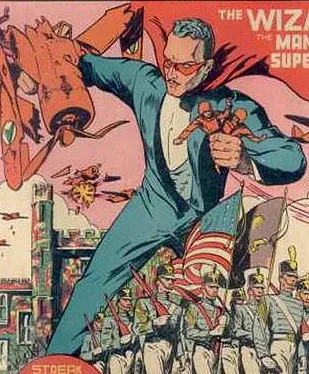
Every week, a new character from the Golden Age of Superheroes who's fallen out of use.
The Wizard, first appearing in Top-Notch Comics #1 in 1939. A debonair vigilante who fights criminals and evildoers wearing a mask, cape and tuxedo--all at the same time–Blane Whitney comes from a long line of heroes who all fought to defend America since its founding. With this ancient heritage the Wizard countless inventions and vehicles, as well as skills he has mastered such as hypnosis, telepathy and clairvoyance.
Contact the author at amparkerdc@gmail.com.