The R&D Credit and the OECD Global Min Tax
Why the top U.S. business tax credit isn't compatible with the OECD plan, and why this is creating a political firestorm at home.

Today, the U.S. is known as a tech behemoth, still the home of Silicon Valley and where entrepreneurs from around the globe go to find the support and talent they’ll need to invent the Next Big Thing.
In the 70s, though, it was a different story. U.S. manufacturing was old and clunky, Japan was rising, and it was beginning to look like the glory days were past.
Congress thought it had a solution in the early 80s–a new credit for research and development. Enacted through the Economic Recovery Act of 1981, it provided a generous new tax incentive that matched spending on new inventions or innovations on a dollar-for-dollar basis. Just how much the credit contributed to the American tech booms that followed has been debated by experts. Perhaps it only gave companies a slight nudge towards where they were going anyways. Nevertheless, the credit has gained a near-sacred status in Congress, protected by both parties even as they desperately look for ways to raise new revenues elsewhere.
Yet, the credit is coming under threat from outside, thanks to the Organization for Economic Cooperation and Development’s 15% global minimum tax. The 141-country agreement, which was heavily supported by President Biden, could encourage other countries to enact new taxing rules that target U.S. companies when they use incentives such as the R&D credit. This has become a rallying cry for Republicans critics of the agreement, who have threatened everything from retaliatory taxes to cuts in U.S. funding to the OECD in response to the plan.
It’s not just the R&D credit–the OECD global minimum tax, also known as Pillar Two, can target any incentive or credit that lowers a company’s effective tax rate. That includes credits for green energy development or affordable housing. But there are hopes that nuances in how Pillar Two calculates income could protect those credits, as well as others.
For R&D, though–undoubtedly one of the most important credits in the entire U.S. Tax Code–companies are just out of luck, apparently. There doesn’t seem to be a pathway to providing cover for this policy, especially as other countries have already changed their laws to conform incentives to the OECD guidelines. The U.S. role in these negotiations, as both the most powerful player in the room and somewhat of an outlier in tax practices, doesn’t allow for much leeway on this issue. Even as it creates political fireworks at home.
Because of how many countries Pillar Two needed to cover, the OECD opted to use financial accounting principles as the basis for a new measure of taxable income. Even though financial reporting standards have an entirely different goal than tax rules, repurposing them to become a universal tax base seemed easier than coming up with ways to reconcile more than 100 different tax codes. While the OECD ultimately needed to make plenty of tweaks of its own, the starting point is that countries use financial reporting rules, both of profit and of taxes paid, to determine whether a given corporate entity is above or below the 15% global minimum tax rate.
Tax credits, by definition, lower a company’s effective tax rate. They often achieve the effect of spending, but for a variety of reasons–both political and practical–countries seek to achieve certain social or economic goals through the tax code, rather than direct appropriations. Generally, the OECD rules treat credits as a reduction of an effective tax rate, and don’t take into account the reasons why those incentives may have been enacted. While many of the goals are worthy, to come up with a universal list of exceptions would be impossible, OECD officials said.
One exception is for refundable tax credits–if a credit can be immediately exchanged for cash, the OECD opted to treat it as more like a subsidy than a tax benefit. It still creates a reduction in the effective tax rate, because it raises a company’s income (rather than lowering its amount of tax payments). But the effect is less drastic, and less likely to push a company away from using the credit in the first place.
Many of the green energy credits enacted by the 2022 Inflation Reduction Act are transferable–companies that receive the credit can’t get a refund from the government, but they can trade it with another company in exchange for cash. U.S. officials have pushed for Pillar Two to count these as refundable, and so far the OECD hasn’t come down one way or another.
Recent OECD guidance did include an option for “qualified flow-through tax benefits,” that will likely cover many credits for affordable housing.
But for R&D, it doesn’t look like there’s a fig leaf big enough to cover it. The only other option would be for Congress to change the law and make it refundable–but, for a few different reasons, that seems out of the question.
First of all, Congress isn’t in the habit of making frequent tweaks to its laws to satisfy global standards. That’s just not how we do things. Recently, making tweaks at all has become something of a hardship in the polarized and calcified legislature, although lawmakers still do manage to come together and pass something every few years. Indeed, the R&D credit itself was extended many times in bills known as “Tax Extenders,” temporary extensions of scheduled expirations normally passed at the end of the year. The PATH Act of 2015 made it permanent–more on that in a bit.
There are also valid reasons for lawmakers to be wary of making credits refundable–especially credits of this size. Non-refundable credits can only be used by companies with taxable profits, or that expect to see them in the near future. Otherwise, there’s nothing to credit them against. That’s at least a limiting principle that keeps the credit from going to too many unworthy or suspicious ventures. Would refundable R&D credits lead to a flurry of questionable startups and outright frauds? A 2016 report from the U.S. Treasury Department’s Office of Tax Policy said “the potential for significant taxpayer abuses of the credit would likely lead to an increase in administrative and compliance costs.”
Nevertheless, some argue that the R&D credit, and more tax credits in general, should be refundable. Maybe startups teetering on profitability are exactly the companies that government should be supporting. And Congress actually has experimented with refundability for the credit, sort of. The aforementioned PATH Act allowed qualified startups to use some of the R&D credit against employee payroll taxes. This still wouldn’t count as refundability for the OECD, but economically it’s similar, since payroll taxes aren’t based on corporate income. The Inflation Reduction Act expanded this provision–perhaps in a few years we’ll get a better sense of what an overall refundable credit would look like.
And it’s not like the R&D credit would be given out like a party favor–it still must be tied to legitimate R&D expenses, spelled out in the code.
That’s another side of this that hasn’t gotten as much discussion, the spending side. Unlike the patent and innovation boxes that Europe loves so much, the value of the U.S. R&D credit is based on the amount of spending, not the amount of income generated by the patents that are produced. That gives it a steadier and presumably lower upward limit.
One key feature of Pillar Two is the substance-based income exclusion, an exemption based on tangible assets and payroll. It’s meant to ensure that the tax only falls on income that’s intangible–that has likely been shifted from the jurisdiction where the value was created. I still wonder how often a company that uses the R&D credit would have so much income–and such a discount from the credit–that it creates a huge return beyond its substance. Apparently, the folks that have the numbers have crunched them and found there’s an issue, or we wouldn’t be talking about it. (One x-factor is that companies can receive the credit even if they’ve contracted out the spending–so they might not be the ones with the tangible assets and payroll themselves.)
This is where a safe harbor or some other administrative convenience could come in, and provide companies some protection, or at least avoid needless compliance work for companies whose spending puts them far outside Pillar Two’s scope. If companies can prove a given amount of real spending in a jurisdiction, perhaps they deserve some protection, or a rebuttable presumption of innocence.
Ideally, this is how the substance-based carveout is supposed to work. It distinguishes between genuine tax avoidance and when companies are using incentives for real activities. Maybe the R&D credit is good or bad policy–but it's hard to argue that, on its own, it's an example of base erosion or profit-shifting.
Figuring out a way to thread this needle is one of many steps the OECD could take to try to make implementation a bit easier, and bring this plan closer to a working system. Although, at this point, it's hard to imagine that an answer to the R&D question would satisfy the Republican critics.
Things have been set in motion beyond the point of reversal. Perhaps what's needed is a credit for research in how to turn back time.
DISCLAIMER: These views are the author's own, and do not reflect those of his current employer or any of its clients. Alex Parker is not an attorney or accountant, and none of this should be construed as tax advice.
LITTLE CAESARS: NEWS BITES FROM THE PAST WEEK
- Republicans kept up pressure on the OECD deal this week, releasing a report from the Joint Committee on Taxation that seems to show that the Pillar Two deal could cost the U.S. more than $100 billion in revenue over the next 10 years. Maybe a lot more. What stood out to me from the report is how wide some of the variations are, based on different assumptions of how corporations will respond to the new incentives. This could mean that the JCT's figures are little more than guesswork, and it also shows how little we know about the big tax picture. But even under the most generous assumptions, it still shows the U.S. losing.
- The U.S. Senate approved a tax treaty, something it does less often than a blue moon. This one, with Chile, was signed all the way back in 2010. Even as the treaties themselves are pretty non-controversial, the treaty approval process has been gummed up for years. This is largely due to blanket objections from Sen. Rand Paul, R-Ky., and others over ancillary issues having to do with the Foreign Account Tax Compliance Act. The hangup gives you an idea of why observers are so skeptical that the Senate would ever approve a multilateral agreement for the OECD tax plan.
- Speaking of the OECD, it announced Wednesday that four countries have had their tax systems removed from potential harmful tax practices, after they made legal changes to their tax incentives. This comes out of a 2015 agreement that IP-based incentives like patent boxes need to be backed with a "modified nexus" of real activities. There's not much to say about the release itself (way to go, Aruba and San Marino!) but these releases always make me wonder why the OECD didn't try to leverage its experience on this issue to help with the Pillar Two plan. An exemption for credits which meet this standard--however subjective that might be--could remove a lot of these conflicts.
PUBLIC DOMAIN SUPERHERO OF THE WEEK
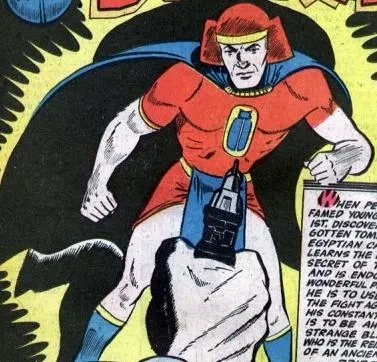
Every week, a new character from the Golden Age of Superheroes who's fallen out of use.
The Scarab, first appearing in Startling Comics #34 in 1945. Peter Ward was an Egyptologist, apparently unaware that he was also the reincarnation of Kor, an ancient Egyptian priest of Ra, the sun god. This entitled him to a "mystical scarab ring" which turns him into "The Scarab," a flying, bulletproof superhuman. Appropriately, his sidekick is a black cat who's also a reincarnated Egyptian priest.
Contact the author at amparkerdc@gmail.com.