Amount B and Digital Goods
Whether or not the OECD's promising "Amount B" project for developing countries should delve into the digital realm is shaping up to be one of the key disagreements between tax authorities and taxpayers.


Back in August, I noted that the Organization for Economic Cooperation and Development's “Amount B” project, to streamline routine distribution activities and prevent unnecessary international tax disputes in developing nations, didn’t include the sexy tax topics like the taxation of digital assets or online marketplaces.
Maybe I should have been more precise–based on public comments released by the OECD on Sept. 20, whether or not the system should include digital goods at all has become one of the key debates between corporate taxpayers and the nonprofit groups representing (or claiming to represent) poorer, low-capacity jurisdictions.
Given that many developing nations have said they see Amount B as the only provision in the OECD’s entire Two-Pillar project likely to give them increased tax returns, you might think they want to see it given as broad a scope as possible. But in this case, it’s the taxpayers hoping to include digital goods and services in the Amount B system, while the nonprofit advocacy groups argue that they should be left out.
“The distinction in the consultation draft between tangible and digital goods and services signals, incorrectly, to tax authorities that the distribution of digital products do not constitute base-line distribution activities and, therefore, require higher returns,” wrote the National Foreign Trade Council in its comments. “Inherently, this will result in further disputes and uncertainty, contrary to the OECD’s stated goals.”
The group added that failing to include digital goods indicated that “the OECD has veered off course from its initial objectives.”
On the other hand, the International Lawyers Project, a “pro bono legal service provider for governments as well as various civic actors,” argues that digital goods are inherently different from tangible goods, and difficult to disentangle from high-value functions.
“The distribution of digital goods is a complex area, as it is difficult to draw the line between them and intangibles,” the ILP wrote. “Moreover, the economically relevant characteristics of distributors of tangible goods and digital goods are innately different.”
This isn’t the only disagreement in the comments, but it’s one that seems to demonstrate why designing this proposal could be more complicated than it sounds. It also highlights the widely divergent views of how to tax the digital economy generally–what was the original task for the OECD when it began this tax project in 2017.
Amount B is part of Pillar One, which is itself part of the larger “Two-Pillar Solution to Address the Tax Challenges Arising from the Digitalization of the Economy.” The overall project focuses on issues, like tax base erosion by companies in the tech sphere and the alleged non-taxation of digital transactions, which are primarily (although not exclusively) seen as the tax equivalent of First World Problems. To ensure that the developing world stayed engaged in the project, the OECD included Amount B to address resource allocation issues among smaller, poorer countries whose tax authorities feel overwhelmed by the challenge of enforcing complex international tax rules.
This new policy would seek to free up capacity in tax administrations by streamlining the pricing and taxation of marketing and distribution activities that should be regarded as routine. One reason that they can trip up tax authorities in these countries is the lack of adequate comparable assets, which are used to price transactions within corporate groups. Through Amount B, the OECD seeks to set up simplified formulas for pricing–within the range of how they’re supposed to be priced now–so that neither the taxpayers or the tax administrations have to go through the comparables analysis every single time. It still hasn’t been decided if this would be something that the tax authority could impose on corporations, or a safe harbor that could be elected into. But either way, it could free up resources for governments while also giving taxpayers more certainty.
The catch is that defining “baseline marketing and distribution activities” isn’t easy, and a poorly conceived scope could end up increasing disputes rather than decreasing them. Would excluding digital goods from the definition create yet another arbitrary dividing line? Or would including them invite corporations to try and fit more important digital transactions into the framework, a Trojan horse to ultimately avoid fair pricing for lucrative online value chains?
This is apparently going to be one of the major fault lines in upcoming debates as the policy gets finalized.
Developing countries’ opposition to including digital goods in Amount B is likely more about preserving policy options in the future, than protecting tax revenue today. While the digital profits in these markets is small, it’s also growing, and some developing countries have begun to experiment with digital services taxes, digital value-added taxes and other ways to capture this income.
An expansive Amount B scope could cut off the potential for some of these taxes.
This could end up being important not only for the overall project–which needs some level of participation from developing countries to remain viable–but the international tax system as a whole. If Pillar One’s Amount A ultimately doesn’t materialize, as many feel it won’t, Amount B could live on in some form, taking on a greater role in global tax policy. The design choices made now, and the basic principles behind them, could have far-reaching implications.
DISCLAIMER: These views are the author's own, and do not reflect those of his current employer or any of its clients. Alex Parker is not an attorney or accountant, and none of this should be construed as tax advice.
A message from Exactera:
At Exactera, we believe that tax compliance is more than just obligatory documentation. Approached strategically, compliance can be an ongoing tool that reveals valuable insights about a business’ performance. Our AI-driven transfer pricing software, revolutionary income tax provision solution, and R&D tax credit services empower tax professionals to go beyond mere data gathering and number crunching. Our analytics home in on how a company’s tax position impacts the bottom line. Tax departments that embrace our technology become a value-add part of the business. At Exactera, we turn tax data into business intelligence. Unleash the power of compliance. See how at exactera.com
LITTLE CAESARS: NEWS BITES FROM THE PAST WEEK
- The Senate Finance Committee gave Internal Revenue Service Chief Counsel Nominee Marjorie Rollinson some (relatively) light quizzing during a hearing Thursday. The nominee, who would be one of only two political appointees to the agency (along with the commissioner), is widely respected by both parties and is seen as a non-ideological pick, so there’s unlikely to be much of a problem with her confirmation. Senators instead used the forum as a chance to harp on many of their grievances with the Biden Administration’s tax policies–including the OECD global minimum tax project. In his opening statement, Sen. Mike Crapo, R-Idaho, the committee’s top Republican, decried the resources that the IRS would expend mitigating double taxation “it created by unilaterally committing to a global tax deal that undermines U.S. interests.” One interesting note, he also claimed the undertaxed profits rule “likely violates our existing bilateral tax treaties.” This is an issue that many have raised, but hasn’t always been a focus for Republican critics. It’s also an issue that the chief counsel, as Treasury’s top legal advisor, may need to address if there are challenges to the rules down the line.
- Aussie tax politics has been dominated by recent revelations that an employee at PwC leaked information gained through contracts with the country’s Treasury to affected clients. The government announced reforms in August and now has released detailed consultation documents, which include proposals to beef up the board charged with investigating misconduct among tax practitioners. Plenty for those who’ve been following the scandal to chew over here.
- The OECD released earlier this week a peer review report for its country-by-country reporting system, created nearly a decade ago by the 2015 Action Plan on Base Erosion and Profit Shifting. (A precursor to its current Two-Pillar project.) The reports are supposed to highlight areas of potential noncompliance or base erosion by outlining where corporations report income, pay taxes, and other factors like employees. While many nonprofit groups have pushed for the reports to be public, so far they’re confidential and only exchanged between tax authorities. (Although other efforts for full transparency continue.) The peer review finds widespread compliance and participation in the information exchanges, although it gives recommendations for improvement to 30 jurisdictions, out of 110 participating. Interestingly, one of those jurisdictions is the United States, which the OECD says should sign more exchange agreements and tweak its revenue definition to conform to the global norm.
There's a very strong chance that the next time I write this newsletter, it will be amid a U.S. government shutdown--what's turning into a disturbingly regular occurrence here in Washington. Folks in other countries likely have a hard time understanding the weird law and politics that leads to this. (No one here really gets it either.) The U.S. Treasury Department released a shutdown plan Thursday, which shows that much of the Internal Revenue Service will be furloughed until Congress can pass new appropriations. International tax is likely to be relatively unaffected–one of the exempted categories is "preservation of government property" which includes a lot of enforcement and litigation. But if this drags on, it could hamper the department's efforts to implement the Inflation Reduction Act as well as continuing negotiations at the OECD.
PUBLIC DOMAIN SUPERHERO OF THE WEEK
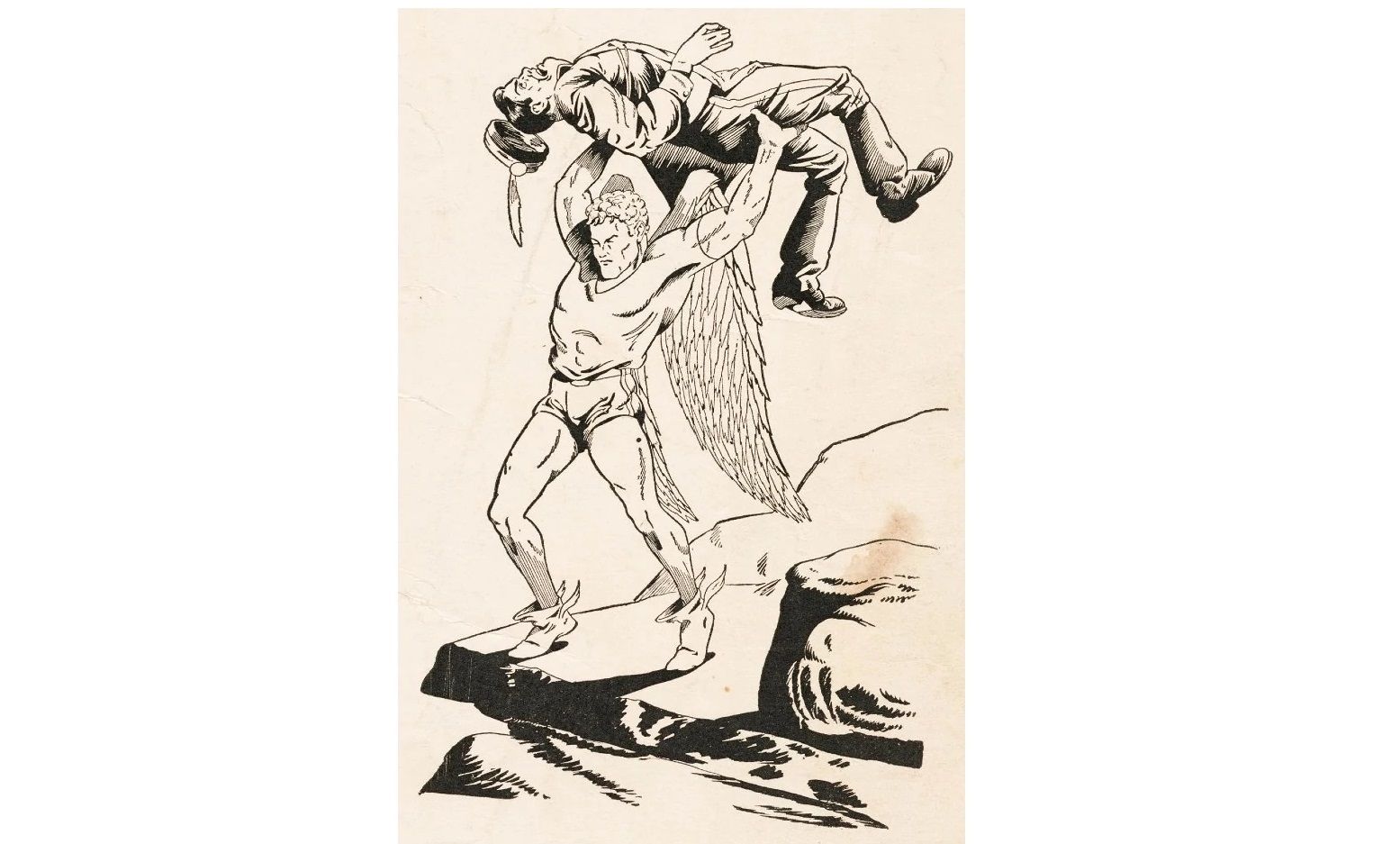
Every week, a new character from the Golden Age of Superheroes who's fallen out of use.
Icarion, whose first and only appearance was in Colossus Comics #1 in 1940. This apparently Greek mythology-inspired winged avenger was advertised as an upcoming character but then never seen again. Perhaps he flew too close to the sun.
Contact the author at amparkerdc@gmail.com.