CAMT, GAARs and Tax Consistency
Treasury has created a new general anti-abuse rule for the controversial corporate alternative minimum tax--why it could stand on shaky ground.


GAARs (General Anti-Avoidance Rules) are the odd duck of the international tax system–not just because they sound like a pirate with a cold.
In theory, they’re a wild card for tax authorities, to play when the rest of the cards don’t quite give them the hand they want. No matter how meticulously legislatures construct tax laws to be impermeable, there’s always a clever practitioner who finds a way around or through the written rules. That’s where the anti-avoidance rules (sometimes called anti-abuse rules, and the distinction isn’t totally clear) come in, nabbing the avoider anyway for violating the spirit of the law even if the letter of it was technically followed.
For tax authorities, it’s heads I win, tails you lose. Pay up either way.
In reality, anti-avoidance rules can be trickier and more limited in their application, with courts often viewing them with a skeptical eye and authorities shying away from potential fights. They’re inherently subjective, and potentially disruptive to a stable system.
The United States doesn’t have an overall tax GAAR, strictly speaking, although it has a similar concept with the economic substance doctrine. That principle, initially created by the Supreme Court in 1935 and not codified into law by Congress until 2010, has also been whittled down by court precedents and administrative practice into a narrow, rarely-used tool. But there are indications that this might be changing.
There are a few examples of mini-GAARs, restricted to a particular code section, sprinkled into U.S. law, however. Subchapter K, governing certain kinds of partnerships, has a detailed anti-abuse rule to ensure "proper reflection of income," for instance.
And now there’s another, in a recent 600-page package of proposed regulations released by the Department of the Treasury last month for the 15% corporate alternative minimum tax. The CAMT (“cam-tee” as it’s known) was created by the 2022 Inflation Reduction Act but has only recently taken effect, and is still being worked out by the government and practitioners.
The 15% minimum tax (not to be confused with the 15% global minimum tax, an entirely different regime) is based on financial accounting data, rather than the tax code. It came about after various studies showed that many corporations paid little in taxes in years when their profits, as reported in financial statements, were large. From the (widely debated) assertion that this indicated these corporations were paying less in taxes than they should, the CAMT was devised as a backstop to ensure they still paid a minimum level of tax, even if they had been following the tax code.
Sort of like a GAAR, come to think of it.
Among other issues, one problem that has arisen with the CAMT is that financial accounting is complex, and fitting it to be parallel to the tax system has proven to be a monumental task. Already, a number of potential issues have arisen, especially in the international tax area, since CAMT applies on worldwide income. There is potential double counting of income from foreign subsidiaries as well as an array of questions when there are crossborder mergers and other transactions.
Probably anticipating this, lawmakers gave Treasury wide leeway in the IRA to adjust CAMT's measurement of income if it "determines necessary to carry out the purposes of this section," a somewhat unprecedented level of discretion in implementation. (The 2017 Tax Cuts and Jobs Act didn’t include that kind of authority, and the department has spent a lot of time and effort dealing with disconnects and overlaps in the massive law while trying not to exceed its power.)
Using its authority, Treasury included a "general anti-abuse rule" in its recent regulations, allowing the department to disregard or recharacterize an arrangement if it determines that the arrangements has "a principal purpose of avoiding the application of the corporate alternative minimum tax rules." There are further rules for crossborder, related-party transactions, including a requirement for the "clear reflection of income," referencing the transfer pricing rules in Section 482.
The anti-abuse rule isn’t actually mentioned in the CAMT statute itself. It’s a creation of Treasury, using its Congressionally-mandated power. It's not that the department is cutting corners--did I mention the regulations were 600 pages?--but on top of the array of (often taxpayer-favorable) tweaks, the department included an entirely new layer against abuse in this untested area. Despite these voluminous rules, there will surely be scenarios or interactions which this new tax base doesn't anticipate or address, and will require a broader backstop to protect its integrity, in Treasury's view.
Some commenters have noted that this rule could be threatened by the Supreme Court’s recent decision in Loper Bright, scaling back the authority of executive agencies to interpret ambiguous statutes. (See here for my discussion with Iowa professor Andy Grewal for further thoughts on Loper Bright’s tax implications.) Of course, the IRA’s grant of authority to Treasury is rather unambiguous, so they may be in the clear–but I could imagine an argument that for the department to create a whole new, wide-ranging anti-avoidance rule out of whole cloth is still too far.
A likelier court challenge could be whether it’s constitutional for Congress to grant that much authority in the first place. This Supreme Court could be skeptical of instances where Congress, with the constitutional mandate to set the tax code, seems to evade that responsibility by throwing it to the executive branch. It would still be a steep climb, but the current Supreme Court hasn’t been shy about knocking down precedent–and there’s no shortage of taxpayers eager to go to court to protest their tax bill.
There's a bit of irony here--the CAMT uses financial accounting information partly under the idea that it offers a plainer, more accurate view of a company's profit. But to make it really work as a tax system, Treasury is including broader, intention-based safeguards where the accounting system either disconnects or falls short. Will the Organization for Economic Cooperation and Development feel the need to do the same for its Pillar Two global minimum tax, which also uses accounting rules as the basis for its tax base?
Rules like these highlight the limits of words. I was actually an English major in college, not accounting or pre-law–and I’m kind of fascinated with the way that language, no matter how carefully and clinically devised, has no inherent meaning beyond a reader’s subjective interpretation. It’s not mathematics, though my calculus professor mom would also probably note that math is subjective too. (What are numbers but more words?)
In this new, unprecedented international tax environment where multiple international systems (new variations on both financial and accounting principles) mesh together, legislatures are finding they have no choice but to add magic asterisks to the law for the situations they can never anticipate.
DISCLAIMER: These views are the author's own, and do not reflect those of his current employer or any of its clients. Alex Parker is not an attorney or accountant, and none of this should be construed as tax advice.
A message from Exactera:
At Exactera, we believe that tax compliance is more than just obligatory documentation. Approached strategically, compliance can be an ongoing tool that reveals valuable insights about a business’ performance. Our AI-driven transfer pricing software, revolutionary income tax provision solution, and R&D tax credit services empower tax professionals to go beyond mere data gathering and number crunching. Our analytics show a company’s tax position impacts the bottom line. Tax departments that embrace our technology become a value-added part of the business. At Exactera, we turn tax data into business intelligence. Unleash the power of compliance. See how at exactera.com.
Thanks for reading! Don’t forget, you can sign up here for a Emperor Subscription, to get extra bonus content, including interviews with newsmakers in the tax field and deep dives on various international tax topics. Subscribe for three months free!
The Emperor Subscription will also give you access to past content, such as interviews with former OECD tax chief Pascal Saint-Amans, former U.S. Treasury official Jason Yen and Tax Foundation CEO Daniel Bunn. (See a full rundown of interviews and other content available through the Emperor Subscription.)
This Friday, I look into the OECD's treaty-shopping rules.
The transactions are handled by Stripe, a safe and secure payment processing platform. Electronic receipt and invoice available. (If anyone has any difficulties subscribing, please let me know.)
You can sign up here for $8/month or an $80 annual payment after a 90-day free trial period. Please consider subscribing!
LITTLE CAESARS: NEWS BITES FROM THE PAST WEEK
- In a new report to the G-20 Finance Ministers ahead of their Rio de Janeiro meeting this week, the Organization for Economic Cooperation and Development put as rosy a spin as it could on the status of the Pillar One global tax agreement, highlighting the unveiling of the subject-to-tax rule treaty while claiming that there is “near full consensus” for the more crucial multilateral convention on Amount A. It’s always better to be near than far, but at the end of the day it doesn’t matter if they’re off by a centimeter or a mile. Indeed, this is the first time they’ve mentioned the Amount A treaty in weeks, and there’s no indication that the participating nations have gotten any closer to finalizing the document than they were when the June deadline passed. But while Pillar One appears all but dead, the OECD notes that Pillar Two is very live, and 90% of applicable companies should be covered by the policy by next year.
- We don’t often get to talk about tobacco taxes, something that doesn’t generate a ton of policy discussion in North America or Europe. But in Latin America, rates of tobacco use remain high and excise taxes on the products are both too low and not only well-targeted, according to a new report from the OECD. The document, produced with help from Bloomberg Philanthropies, draws up a set of best practices to ensure that excise taxes raise revenue in the short-term and curb tobacco use in the long-term.
- A joint report from the OECD, World Trade Organization, United Nations, International Monetary Fund and the World Bank looks at the current state of different climate change mitigation policies. In particular, it highlights the various challenges with carbon pricing, even as it gains momentum in both the developing and developed world. As the movement towards a standardized system to coordinate between pricing and non-pricing measures continues–and as the U.S. remains stuck with an incentives-only approach–these issues will become more and more important in the international tax area.
PUBLIC DOMAIN SUPERHERO OF THE WEEK
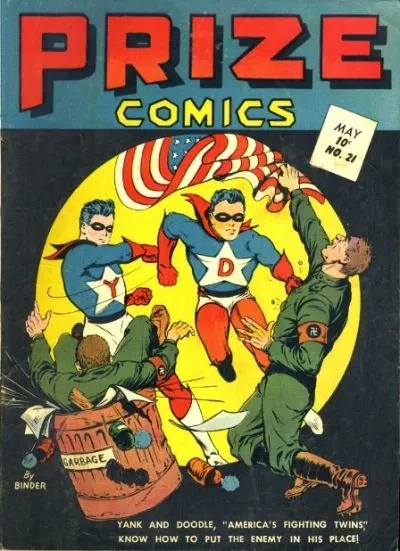
Every week, a new character from the Golden Age of Superheroes who's fallen out of use.
Yank and Doodle, first appearing in Prize Comics #13 in 1941. Too young at 16 to enlist, the brothers decided to fight for their country in disguise. Unaware of their secret identities, their father would eventually become the second Black Owl and fight Nazis in costume as well.
Contact the author at amparkerdc@gmail.com.